When Mark from suburban Denver noticed brown patches creeping into the shady side of his lawn while his raised vegetable beds were soggy no matter how often he watered, he knew something had to change. He had a medium-sized lawn, five tomato plants, and a row of perennial flower beds — each area clearly needed a different approach. This buyer’s guide walks through those exact yard scenarios and matches the right irrigation setup so you can upgrade to a water-saving lawn without guessing.
How to decide between drip and sprinklers: match the problem to the system
First, name the main watering challenge: are you losing water to evaporation and overspray, or are certain root zones staying too wet while others go dry? The simplest distinction is that sprinklers apply water broadly (good for turf), while drip systems deliver water slowly at the soil level (better for beds and veggies). For example, a 1,500 sq ft lawn watered with conventional spray sprinklers can lose a large share of applied water to wind and evaporation during midday hours; switching to lower-pressure rotary nozzles or a smart schedule often cuts that waste. According to the EPA, smart irrigation controllers and better scheduling can save significant water in residential landscapes.EPA WaterSense
Matchups to consider:
- Small lawn with mixed sun/shade: mobile or handheld sprinklers with a programmable timer — easy to target and move.
- Large, uniform turf: in-ground sprinkler system with weather- or soil-moisture smart control to avoid overwatering.
- Vegetable gardens and hedgerows: drip irrigation or soaker lines that feed the root zone directly.
- Flower beds and perennials: low-flow drip emitters or micro-spray to protect shallow roots and reduce fungal issues from wet foliage.
- Potted plants and container gardens: self-watering stakes or slow-release drippers for consistent moisture.
Drip irrigation: strengths, trade-offs, and a realistic setup example
Problem: your veggies wilt in the afternoon but the lawn nearby is fine. Solution: deliver water slowly at the root zones. Drip irrigation cuts water waste by putting moisture where roots can use it; typical savings are 20–50% compared with spray watering in the same area, especially for densely planted beds. A raised-bed vegetable patch with ten tomato plants might use 1–2 gallons per plant per day during peak summer when watered with drippers on a 10–20 minute cycle, versus several times more if using a sprinkler that wets foliage and surrounding paths.
Practical drip components and placement
Components: mainline tubing, pressure regulator, filter, emitters (fixed-rate or adjustable), and simple stakes to keep lines in place. Example layout: run a 1/2" mainline down the bed, branch into 1/4" laterals, then place 1–2 GPH emitters per plant depending on root ball size. For a 4' x 10' bed, two 10' laterals with 8 emitters each is common.
Maintenance and costs
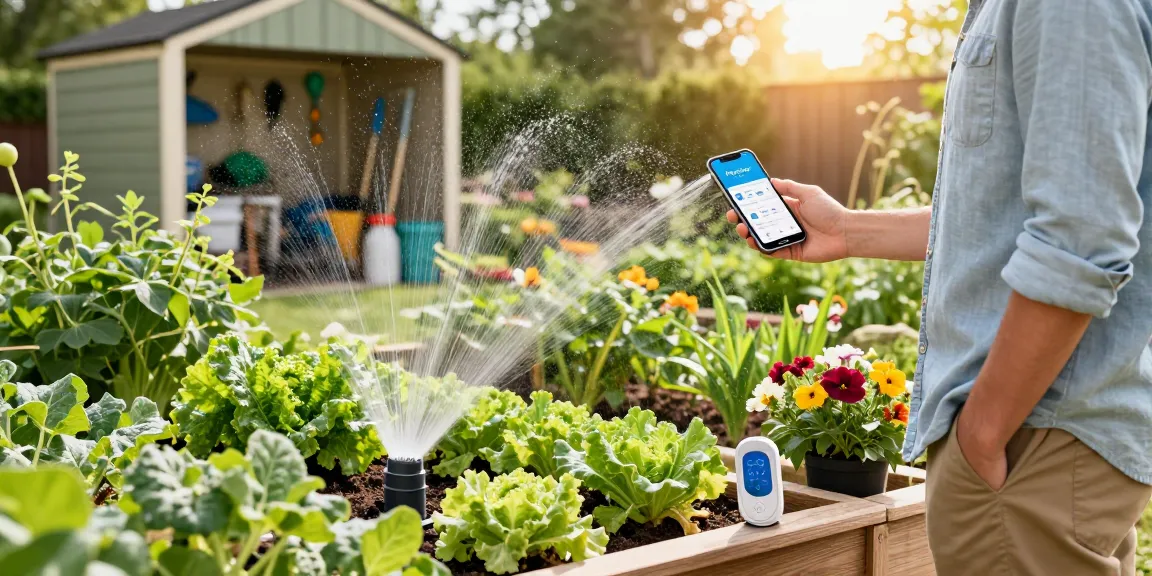
Initial DIY parts for a single bed often run $30–$120 depending on emitter quality; pro-installed systems cost more but are faster. Drip lines need occasional flushing and winterizing in cold zones. A WiFi timer such as the RainPoint model lets you run short, frequent cycles automatically, ensuring consistent moisture without daily attention.
Sprinklers: when they’re still the right choice and how to modernize them
Problem: you have a traditional turf lawn that looks patchy because edges dry out faster than the center. Solution: retrofit or design a sprinkler layout that matches lawn shape and uses smart scheduling. Sprinklers remain the best option when you need even coverage for grass over hundreds of square feet. But the trick is to avoid wasting water through inefficient heads, poor zoning, and watering at the wrong time of day.
Smart upgrades that save water
Replace fixed, high-pressure spray heads with rotary nozzles or install a smart controller that adjusts runtimes based on local weather or soil moisture. For example, replacing old pop-up sprays on a 2,000 sq ft lawn with efficient rotary nozzles and a weather-based controller can reduce annual outdoor water use by a substantial fraction. The EPA has found that smart controllers can save households a notable amount of irrigation water annually when used properly.
ScenarioTraditional sprinkler fixEstimated benefitSmall lawn, mixed sunPortable rotary sprinklers + short morning cyclesLower evaporation, flexible placementLarge uniform lawnIn-ground rotary nozzles + smart controllerUp to 25% water savings vs old sprays
When you need centralized control for several zones (lawn, beds, containers), a WiFi-enabled controller from RainPoint will let you schedule different runtimes and skip watering on rainy days automatically. That’s especially useful when your yard contains a mix of turf and plantings that need separate care.
Combining systems: the hybrid approach for mixed yards
Problem: your property includes turf, a vegetable garden, and ornamental beds — one system won’t suit all. Solution: a hybrid layout that pairs an in-ground sprinkler zone for the lawn with dedicated drip zones for beds and veggies. This keeps each plant type happy and reduces total water use because each zone gets customized timing and flow.
Sample hybrid schedule
- Lawn zone (early morning): two 10–12 minute cycles with rotary nozzles, 3 days/week in summer.
- Veggie beds (late morning or evening): drip emitters on 20–30 minute daily cycles or alternate days depending on soil texture.
- Flower beds (evening): 15-minute drip or micro-spray sessions 2–3 times/week.
Concrete example: Jill in Austin runs her drip vegetable zone for 25 minutes every other morning and her lawn sprinkler zone for three short cycles twice a week; combined, she cut her irrigation use by roughly 30% while her tomatoes thrived. If you want a ready path to upgrade to a water-saving lawn with RainPoint, look for kits and controllers designed to manage both drip and sprinkler zones seamlessly.
Cost, maintenance, and buyer tips to choose the right setup
Problem: you’re unsure whether to invest now or patch the old system. Solution: weigh initial cost vs. ongoing water and time savings. Typical ballpark costs: DIY drip kits for a single bed start around $30–$150; a basic in-ground sprinkler retrofit may run $200–$1,000 DIY depending on parts; professional irrigation installs for a full yard often cost several thousand dollars. But savings add up — switching to efficient irrigation and smarter scheduling often reduces summer water use enough to cover equipment costs in a few seasons in many municipalities.
- Tip: zone by plant type, not just by area size. Lawns, beds, and containers should have separate schedules.
- Tip: choose pressure-regulated drip components if your household water pressure exceeds 50 PSI.
- Tip: winterize drip and sprinkler lines in freezing climates to avoid damage.
Maintenance is manageable: check emitters quarterly, clean filters if present, and test sprinkler coverage twice a season. If you prefer less hands-on time, a WiFi timer and weather-aware controller do the thinking for you and cut unnecessary runs.
Across these choices, the goal is matching system to need — not one-size-fits-all. With targeted drip for root zones, efficient rotors for turf, and a smart controller coordinating zones, a typical suburban homeowner can significantly reduce water waste while keeping every part of the yard healthy.